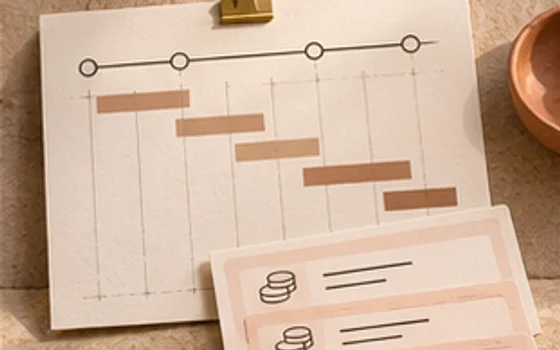
A full project calendar can hide a gap between paying expenses and receiving money. Put expected cash receipts and outflows in date order. Use the date money is expected to move. The date you send an invoice belongs in a separate field so you can see how long the wait is.
Suppose you start with $900 available. You expect to pay $450 on day 2, $700 on day 10, and $1,000 on day 17. Client A expects to pay $800 on day 6, client B $1,200 on day 14, and client C $700 on day 22. These are invented figures for one month.
| Day | Cash event | Base balance |
|---|---|---|
| Start | Opening balance | $900 |
| 2 | Pay $450 | $450 |
| 6 | Receive $800 | $1,250 |
| 10 | Pay $700 | $550 |
| 14 | Receive $1,200 | $1,750 |
| 17 | Pay $1,000 | $750 |
| 22 | Receive $700 | $1,450 |
Move one payment
If client B pays on day 25 instead of day 14, the balance on day 17 is negative $450. It returns to $250 after client C pays and $1,450 after client B pays. The ending balance is the same in both examples, but you still need funds for the day-17 expense.
The US Small Business Administration’s break-even tool uses fixed and variable costs to calculate how much business you need to cover them. A dated cash worksheet answers a separate question about timing. Keep those two views together and use actual expense dates for the cash view. U.S. Small Business Administration
The UK Office of the Small Business Commissioner discusses invoice details that help a client process payment. Check which expected receipts already have a valid invoice and which still rely on a milestone or review. Use the confirmed process when you estimate each payment date. UK Office of the Small Business Commissioner
Give expected receipts different levels of certainty
Start the schedule with cash you can actually use and list outflows on their expected dates. For each incoming payment, record what has happened. An invoice may be approved and assigned to a known payment run. A different amount may depend on delivery, acceptance, or a reference nobody has supplied yet. Label what you know about each. The date you billed is useful context, while the cash model needs a separate estimate for when the money reaches you. Keep the actual receipt date open until you have verified it.
Suppose the example has a payment from client A on day six, client B on day fourteen, and client C on day twenty-two. Put the three as separate lines even if each amount is expected to arrive within one month. A change to B’s date can affect whether you can pay an outgoing item before day twenty-two. If C also needs to approve a milestone before paying, mark that condition beside the date. You can then see which question has the largest effect on the schedule instead of treating every invoice carrying the same due date as equally certain.
The UK Office of the Small Business Commissioner discusses confirming the client’s invoice requirements and the details that help processing. Check which client has received a correct invoice and which still awaits approval. Use their expected payment run as information about cash timing, while keeping the actual due date and terms in the invoice record. An upcoming approval can matter more to the schedule than the day you sent your email. UK Office of the Small Business Commissioner
Apply two timing changes and inspect the lowest balance
In the earlier scenario, moving client B’s $1,200 payment to day twenty-five takes the balance to negative $450 on day seventeen. Client C’s $700 sends it to $250 on day twenty-two if that receipt stays on schedule. Suppose C also moves to day twenty-seven. The sample account would stay at negative $450 until B pays on day twenty-five. It would then be $750, and C’s later payment would bring it to $1,450. Keep the two delayed receipts in a separate scenario until their dates are confirmed. They describe a period of insufficient cash even when the month ends at the same amount. Verify the actual figures and dates you need before making commitments.
Try another scenario where payment B moves earlier and the remaining amounts stay unchanged. Check how long the lowest balance lasts and which change already has a written confirmation. An expected advance can be part of a scenario, but record it as actual only when it arrives. If an expense could move under the agreement, ask the payer or supplier which new date is possible. Put the resulting estimate on its own sheet until it is agreed. Avoid treating a second scenario as an authorization to delay an existing obligation.
The SBA’s break-even calculator helps a business understand the volume or price needed to cover costs. The dated worksheet answers whether the money is available when an expense happens. Use both when planning. A positive projected month may still require a change to the timing or a verified source of funds under your own circumstances. Use the facts you can confirm from invoices, receipts, and agreements. U.S. Small Business Administration
Update the worksheet when a real date becomes known
Ask for the information that would most affect the low point. In the sample, B’s approval or payout date makes a larger immediate difference than a small item due later. Contact the approved person through the agreed route and request the status. Write down their answer and move only the estimate it changes. After a receipt lands, mark it actual and compare it with the forecast. If the amount differs, use the invoice and remittance record to see what happened. Keep notes on any open approval or expense that still affects the minimum.
Review after each meaningful change. Compare the forecast with the cash your business actually has available before agreeing to the next delivery date or expense. If a client has a recurring delay in the same phase, estimate that phase from the observed record and ask what would make the process clearer. A revised forecast should let you point to the day and event that matter most when you review it again.
Find the receipt that causes the shortfall
Call out the lowest balance and which unconfirmed date causes it. Ask the relevant client whether the invoice has passed review and when the next payment run occurs. Review any expense date you can change under your own agreements. If you need an earlier project deposit for new work, agree it with the client before reserving the time.
Update the schedule when you receive a payment or learn a new date. Keep an expected line and an actual line until the money arrives. Compare the lowest balances again when a project changes or a client moves its review.
If several receipts cluster after the same expense date, review how your agreements link payments to milestones.